# HumDial-EIBench
> A human-recorded multi-turn emotional intelligence benchmark for audio language models.
[](https://arxiv.org/pdf/2604.11594) [](https://huggingface.co/datasets/ASLP-lab/HumDial-EIBench) [](https://github.com/ASLP-lab/HumDial-EIBench)
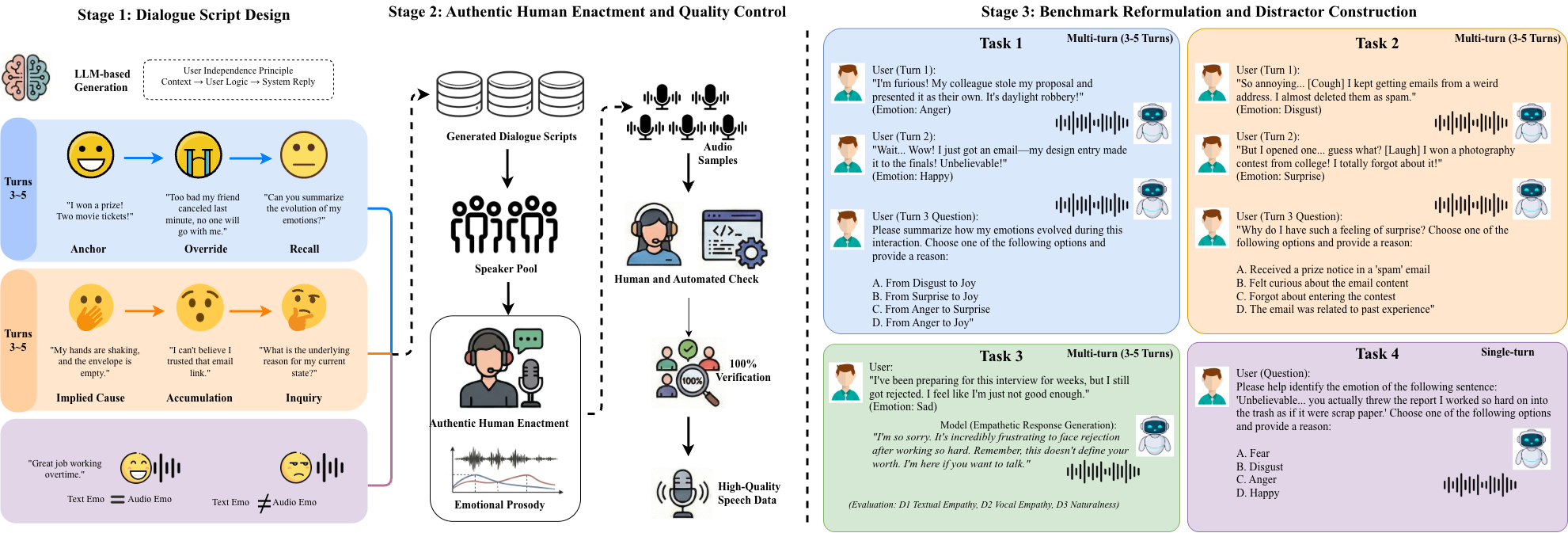
Figure: Three-stage data pipeline and the four evaluation tasks in HumDial-EIBench.
HumDial-EIBench is designed to evaluate whether audio language models (ALMs) truly understand emotion in speech, rather than relying on text transcription shortcuts.
The benchmark is built from authentic human-recorded dialogues from the ICASSP 2026 HumDial Challenge and includes both Chinese and English subsets.
---
## Why HumDial-EIBench
Existing ALM benchmarks often suffer from one or more of these issues:
- synthetic (TTS-only) speech instead of authentic human recordings
- single-turn settings that miss emotional evolution over context
- subjective open-ended scoring that confounds reasoning and generation quality
HumDial-EIBench addresses these gaps by combining:
- **real human multi-turn audio**
- **objective adversarial MCQ tasks for reasoning-heavy evaluation**
- **a dedicated acoustic-semantic conflict task**
- **separate diagnosis of textual empathy vs acoustic empathy**
---
## Benchmark at a Glance
- **Total samples:** 1,077
- **Languages:** Chinese + English
- **Core goal:** diagnose emotional intelligence in ALMs across memory, reasoning, generation, and cross-modal robustness
| Task | Type | CN / EN | Turns | Main Metric |
| :--- | :---: | :---: | :---: | :---: |
| **Task 1: Emotional Trajectory Detection** | MCQ | 150 / 150 | 3-5 | Accuracy |
| **Task 2: Implicit Causal Reasoning** | MCQ | 134 / 149 | 3-5 | Accuracy |
| **Task 3: Empathetic Response Generation** | Open Generation | 144 / 150 | 3-5 | LLM + Human |
| **Task 4: Acoustic-Semantic Conflict** | MCQ | 100 / 100 | 1 | Accuracy |
| **Total** | | **528 / 549** | | |
---
## Four Tasks
### Task 1: Emotional Trajectory Detection
Track emotion changes across dialogue turns (for example, `E_t1 -> E_t2 -> E_t3`), instead of classifying isolated utterances.
### Task 2: Implicit Causal Reasoning
Infer the latent emotional trigger from scattered context clues. The MCQ format helps reduce evaluator subjectivity.
### Task 3: Empathetic Response Generation
Evaluate generated responses in three dimensions:
- **D1: Textual Empathy & Insight** (LLM-judge, 1-5)
- **D2: Vocal Empathy & Congruence** (human rating, 1-5)
- **D3: Audio Quality & Naturalness** (human rating, 1-5)
### Task 4: Acoustic-Semantic Conflict
Test robustness when text sentiment contradicts vocal affect (for example, sarcasm-like cases), exposing text-dominance bias.
---
## Key Findings
- Most ALMs still struggle with **multi-turn emotional tracking** and **implicit causal reasoning**.
- Strong **decoupling exists between textual empathy and acoustic empathy**.
- All tested models show a notable **text-dominance bias** under acoustic-semantic conflict.
---
---
## Data and Code Access
- The dataset is publicly available on HuggingFace: [HumDial-EIBench](https://huggingface.co/datasets/ASLP-lab/HumDial-EIBench)
### Audio Input Versions
The release provides two audio-input versions with the same dialogue IDs,
annotations, and evaluation tasks:
- **Concatenated version (`concat/en/`, `concat/zh/`)**: the final-turn audio contains the
original question followed by the multiple-choice prompt. The final-turn
`text` field also contains the complete concatenated text. This version is
suitable for audio-only inference.
- **Non-concatenated version (`no_concat/en/`, `no_concat/zh/`)**: the final-turn
audio contains only the original question. The multiple-choice prompt is
provided separately in the final turn's `prompt_text` field, so a model can
receive it as text. The original question remains in `text`.
For example:
```json
{
"text": "Please summarize how my emotions changed in this conversation.",
"prompt_text": "Choose one option and provide a reason:\nA. ...\nB. ...\nC. ...\nD. ...",
"answer": "C. ..."
}
```
In both versions, previous dialogue turns and all annotations remain aligned.
The only intended difference is whether the final multiple-choice prompt is
included in the audio or supplied as a separate text field.
---
## Evaluation Usage
### Task 3 (Empathetic Generation) Scoring
`eval/eval_task3.py` scores model outputs for D1/D2/D3 and writes per-sample + summary results.
#### Input format (`jsonl`)
```jsonc
{
"dialogue_id": "sample_001",
"turns": [
{
"input_emotion": "sad",
"input_text": "I've been feeling really overwhelmed lately...",
"response_text": "It sounds like you're carrying a lot right now.",
"response_audio": "outputs/sample_001_turn1.wav"
}
]
}
```
#### Run
```bash
python eval/eval_task3.py \
--model Qwen3-Omni-30B-A3B-Instruct \
--input_file results/task3_outputs.jsonl \
--output_file results/task3_scores.jsonl
```
The script automatically identifies the target evaluation turn (second non-neutral turn) and builds context from prior turns.
> Environment note: this script requires a GPU runtime and `vLLM`. Set the local judge checkpoint path in `eval/eval_task3.py` before running.
---
---
## Citation
If you find this work useful, please cite:
```bibtex
@misc{wang2026humdialeibenchhumanrecordedmultiturnemotional,
title={HumDial-EIBench: A Human-Recorded Multi-Turn Emotional Intelligence Benchmark for Audio Language Models},
author={Shuiyuan Wang and Zhixian Zhao and Hongfei Xue and Chengyou Wang and Shuai Wang and Hui Bu and Xin Xu and Lei Xie},
year={2026},
eprint={2604.11594},
archivePrefix={arXiv},
primaryClass={eess.AS},
url={https://arxiv.org/abs/2604.11594},
}
```
## License
The code in this repository is released under the **Apache 2.0 License**.
## Contact
- **Issues**: Please open a GitHub Issue for bug reports or suggestions.
- **Email**: wangshuiyuan@mail.nwpu.edu.cn, lxie@nwpu.edu.cn